Initiative for Hydrogen in East Germany launches study on economic value and job market potential of the hydrogen economy
The ramp-up of an electricity-based hydrogen economy opens up numerous opportunities for value creation and the labor market in East Germany. To analyze and highlight these potentials, the Initiative für Wasserstoff in Ostdeutschland (IWO) commissioned the WifOR Institute and the Fraunhofer-Institut für Solare Energiesysteme ISE to carry out a comprehensive study. It examines the value-creation and labor-market potentials of the hydrogen economy in the new federal states.
“The hydrogen value chain involves far more than building and operating electrolyzers or using hydrogen in industry and mobility,” says IWO CEO Dominik Härle. “It already begins with research and development and extends through component manufacturing and plant engineering to the export of technologies. East Germany has excellent capabilities in R&D as well as component and plant manufacturing. The study provides us with an evidence-based foundation for the strategic development of the hydrogen economy in East Germany.”
Analysis of the value-creation potential of East German technologies in the global market
The IWO study focuses on the global sales potential of East German technology companies in the context of electrolyzer technologies. Based on a comprehensive analysis of technologies and stakeholders, it identifies existing competencies of companies in East Germany and estimates their potential shares of value creation in a future global market. From this, the study derives potential labor-market effects. It also examines the resilience of industrial value chains in the context of European technology expertise.
Two recognized experts
IWO has brought two recognized experts on board for this task: the WifOR Institute and the Fraunhofer-Institut für Solare Energiesysteme ISE.
The WifOR Institute is an independent economic research institute with a focus on macroeconomic analysis. In the labor-market field, it analyzes the economic and employment-related effects of transformations — from value-creation and employment impacts to skills requirements and strategic implications for labor, industrial, and economic policy.
“Our analyses aim to reliably quantify the value-creation and employment effects that could accompany the expansion of the hydrogen economy in East Germany. The particular strength of this study lies in the combination of technological expertise, economic analysis, and IWO’s clear focus on East Germany. This provides an empirical basis for strategic industrial and labor-market policy decisions,” explains Florian Fickler, team lead for labor market research at the WifOR Institute.
Fraunhofer ISE in Freiburg is one of Europe’s leading research centers in the field of renewable energy. Researchers there work on technical solutions along the entire hydrogen value chain — from materials research through the development and optimization of electrolysis processes to system integration in energy infrastructures.
“We want to show which technological competencies already exist in East Germany and how they can be purposefully expanded,” says Stefan Aschbrenner, project manager for hydrogen infrastructure and technical systems analysis at Fraunhofer ISE.
East Germany pools its strengths for hydrogen
The Initiative für Wasserstoff in Ostdeutschland e.V. (IWO) is the joint platform of the six eastern federal states to advance the hydrogen economy across state borders. It brings together regional expertise and strengths from Berlin, Brandenburg, Mecklenburg-Vorpommern, Saxony, Saxony-Anhalt, and Thuringia. The federal government supports the initiative as a network member.
The founding of IWO stems from a resolution of the 2022 Eastern Prime Ministers’ Conference. It was based on the Riems Declaration, which stated: “East Germany possesses strengths for implementing a hydrogen ramp-up along the entire value chain that can complement one another. Efficient cross-state cooperation offers the opportunity to unlock synergies and reduce costs.”
In this spirit, IWO’s mission is to unlock existing opportunities and potentials and to establish East Germany as a key region for the hydrogen economy. IWO connects actors from politics, industry, science, and administration and promotes cross-regional cooperation among all members. A central goal is to optimize the framework conditions for hydrogen projects.
Hydrogen as a driver of development
With this study, IWO creates an evidence-based foundation for industrial and workforce policy in the context of the hydrogen economy in East Germany. The results are intended to show how East Germany can strategically expand its existing competencies and establish itself as a key region in Europe’s hydrogen ramp-up.
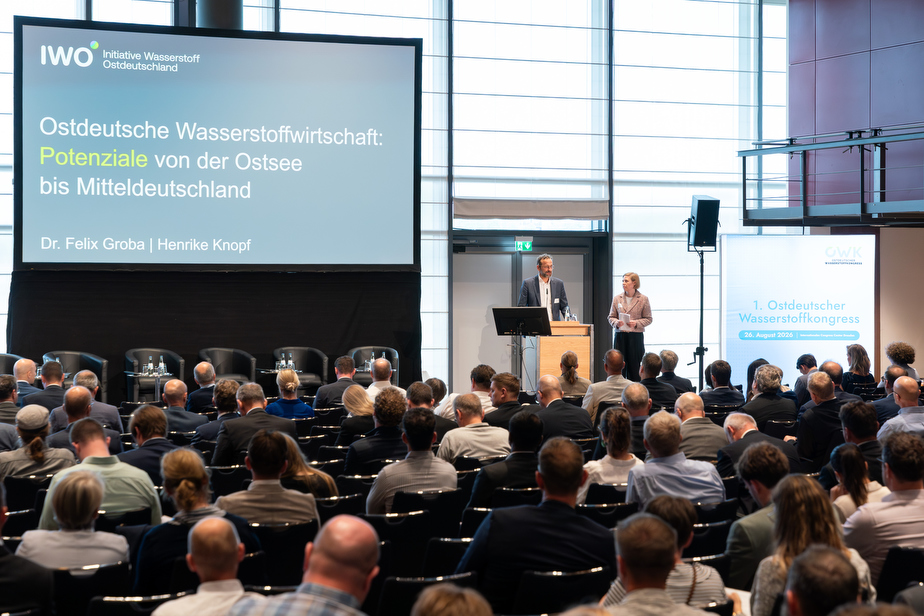
The results will be presented in late summer 2026.
Our Institutes
Media contacts
Initiative für Wasserstoff in Ostdeutschland (IWO) e.V.
Sachsendamm 63 | 10829 Berlin
Public relations
Henrike Knopf | Hydrogen Economy Specialist
M henrike.knopf@h2iwo.de
Project lead
Alexander Spieß | Senior Hydrogen Expert
M alexander.spiess@h2iwo.de